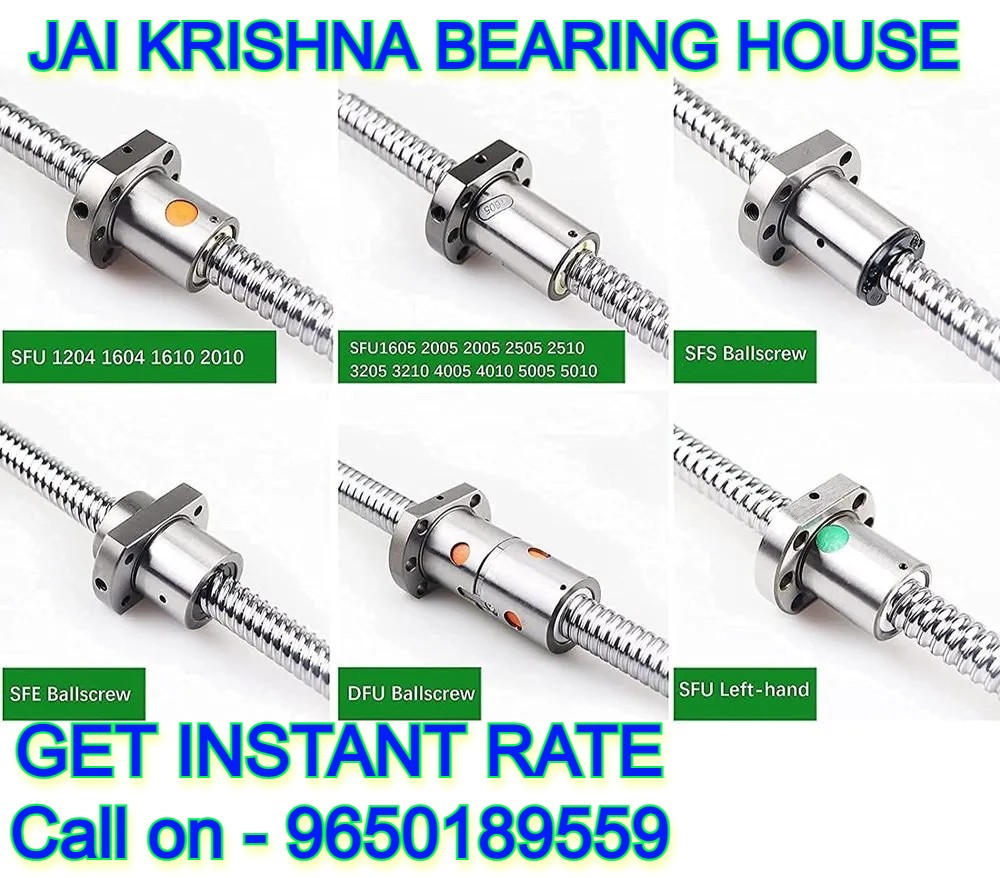
A ball screw (or ballscrew) is a mechanical linear actuator that translates rotational motion to linear motion with little friction. A threaded shaft provides a helical raceway for ball bearings which act as a precision screw. As well as being able to apply or withstand high thrust loads, they can do so with minimum internal friction. They are made to close tolerances and are therefore suitable for use in situations in which high precision is necessary. The ball assembly acts as the nut while the threaded shaft is the screw. In contrast to conventional leadscrews, ballscrews tend to be rather bulky, due to the need to have a mechanism to recirculate the balls.
Another form of linear actuator based on a rotating rod is the threadless ballscrew, a.k.a. "rolling ring drive". In this design, three (or more) rolling-ring bearings are arranged symmetrically in a housing surrounding a smooth (threadless) actuator rod or shaft. The bearings are set at an angle to the rod, and this angle determines the direction and rate of linear motion per revolution of the rod. An advantage of this design over the conventional ballscrew or leadscrew is the practical elimination of backlash and loading caused by preload nuts.